
Nikah Contract Checklist for Muslim Women: Prepare Before Anyone Drafts
Use this private workspace to separate your own wishes from outside pressure, record what has actually been discussed, and prepare precise questions for the right reviewer. It does not generate clauses or decide whether wording is valid in Islam or enforceable where you live.
About this resource and how to share it
Review status: Editorially reviewed for women-first consent, private-data minimization, separation of religious and civil-law questions, non-generator scope and safety escalation. No named scholar, imam, lawyer, registrar, counselor or safeguarding specialist has reviewed this edition. Editorial policy
Sharing includes only this page title and its blank public link—not anything typed into a resource. Printing can include typed content and may send it to a local, network, or cloud printer.
Women-first · private questions · no account · no score
Prepare your Nikah conversations without turning a worksheet into a contract
This is a private place for a woman to organize what she wants, what was actually discussed and which questions belong with the right qualified person. It does not write clauses, decide an outcome, provide legal advice, answer a religious question or establish that anything is agreed, valid or enforceable.
1. What I want
Your preference, what was discussed and what remains unresolved.
2. Scholar or imam question
Religious questions only, taken to someone suitably qualified for that scope.
3. Local family lawyer or registrar question
Local civil, legal and registration questions only.
Private notes and blank-workspace actions
Printing is the only action below that includes your entries. Sharing and downloading use fixed blank resources and receive no draft data.
No private entry is attached to the blank share or download actions.
One issue · three different questions
Do not ask one person to answer beyond their role
What do I freely want?
Write your own preference before a relative, potential spouse, template or online debate turns an option into your assumed position.
What is my religious question?
Ask a suitably qualified scholar or imam a precise question with the relevant school, facts and proposed wording. Do not treat this page as the answer.
What is my local civil-law question?
Ask a family lawyer, registrar or other appropriate local professional what creates, records or may enforce a civil marriage in the relevant jurisdiction.
A safer sequence before the Nikah ceremony
- 1. Think privately first.
Record what you want, what is flexible and what is still genuinely unknown before negotiating wording. - 2. Discuss the real-life expectation.
Use ordinary examples about work, housing, family, money and conflict. A label can hide two very different plans. - 3. Separate the reviewers.
Religious treatment, civil registration, legal enforceability, finances and safeguarding are different questions for different qualified people. - 4. Review the exact wording.
A conversation summary is not a clause. Have the actual proposed document reviewed before signing or treating it as final. - 5. Keep free consent visible.
Each adult can pause, seek independent advice or decline. Family involvement cannot replace the bride's or groom's decision. - 6. Keep copies appropriately.
After signing, ask the responsible reviewer where originals and copies should be stored and how future changes are documented.
A clause is not a cure for coercion or abuse. If saying no, asking for time or seeking advice may create danger, prioritize a safe device and local specialist support over finishing this worksheet.
Blank cards only · no private entries
Save or share one useful preparation question
Choose a fixed card to keep, send to someone you trust, or save on Pinterest. The image and QR code contain only the published prompt and a link to this blank workspace. They never contain your selections, notes, name, account, or anyone else's information.
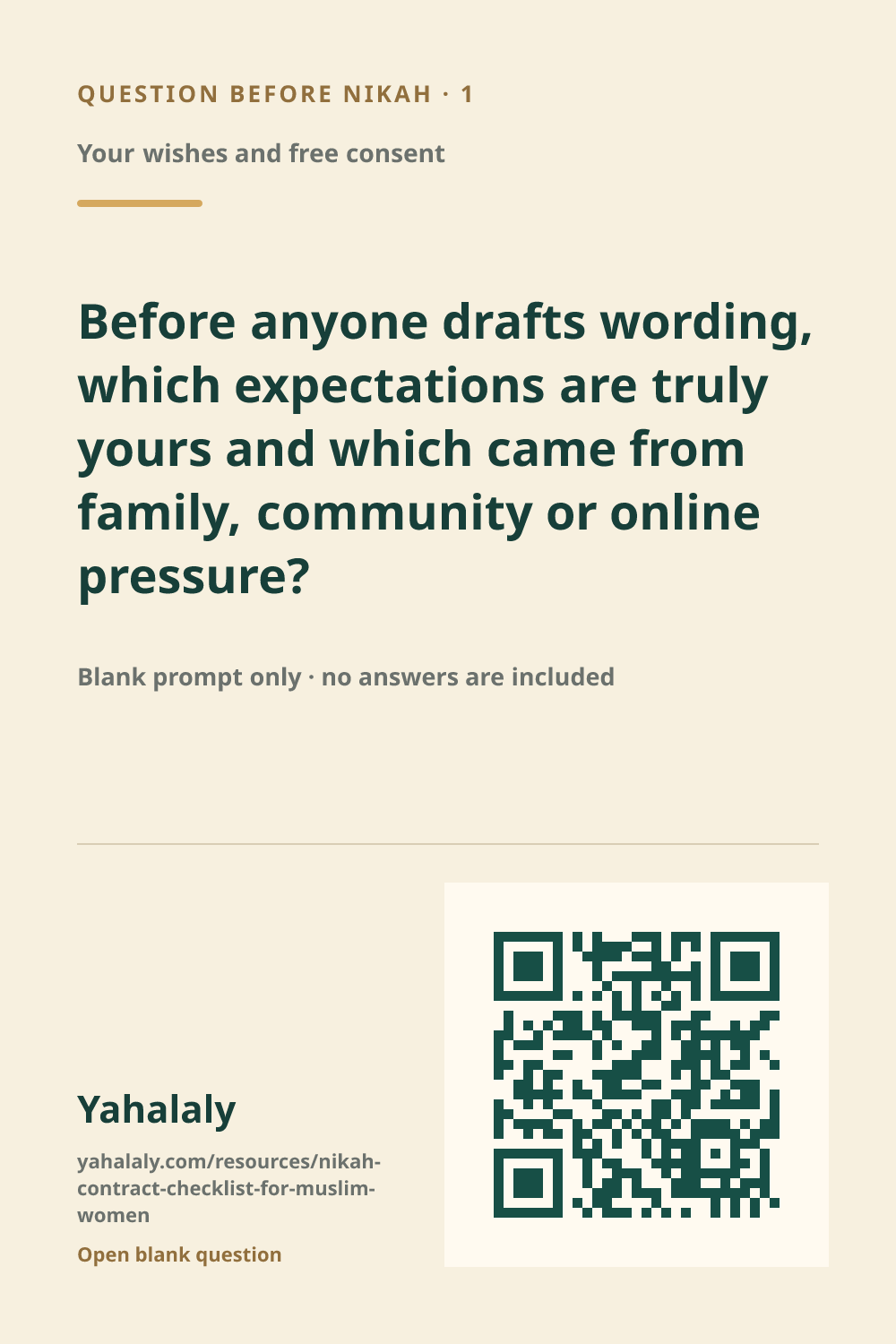
Your wishes and free consent
This is a conversation prompt, not proposed contract language. The linked workspace keeps religious review and local civil-law review separate.
Contract preparation cannot replace knowing the person
Good wording cannot establish character, identity, safety or future conduct. Use the private potential-husband evidence journal to separate claims from conduct, and the 35 questions before Nikah to discuss the life that the document is supposed to support. If a money request, hidden identity, threat or pressure appears, move to the Safety and Verification Center instead of trying to repair the situation with wording.
Sources and scope
These sources support the specific safety, privacy, product, and cited Islamic concepts identified below. The questions, examples, and worksheet structure remain Yahalaly editorial guidance, not a fatwa, professional assessment, or compatibility guarantee.
- Canadian Council of Muslim Women — Muslim Marriage Contract Toolkit
A Canadian resource showing why women may prepare marriage-contract questions and explanatory notes. Its sample wording and jurisdiction do not establish religious validity or civil enforceability elsewhere, and Yahalaly does not reproduce or adapt its clauses.
- Brandeis University — Marriage Contracts in Islamic Jurisprudence
An academic overview describing material differences among Sunni legal schools in their treatment of stipulations and warning that civil enforceability may differ. It is background, not an individual ruling or current local legal opinion.
- GOV.UK — Plan a marriage ceremony in England and Wales
Official guidance explains notice, registered religious buildings, authorised persons or registrars, marriage documents and registration in England and Wales. Procedures, costs and eligibility can change; check the current local route for the intended ceremony.
- Federal Portal Germany — registering a marriage
An official example of jurisdiction-specific civil-marriage procedure through the responsible registry office. It does not determine the treatment of a religious contract or provide advice for another jurisdiction.
- Qur'an 4:4 — bridal gifts
A primary Islamic text relevant to mahr. This page does not derive an amount, clause, contract term or ruling for an individual case from the verse.
- UK Government — Forced Marriage Unit guidance
Official UK guidance and support routes when free consent is absent or someone faces pressure. Its service and jurisdiction are specific; Yahalaly does not assess whether an individual situation meets a legal definition.
Frequently asked questions
What conditions can a woman put in a Nikah contract?
This workspace deliberately does not publish a universal list of valid clauses. Religious treatment differs across schools, teachers and circumstances, while civil enforceability and registration rules differ by jurisdiction. It helps a woman identify the outcome she wants, then turn it into a precise question for a suitably qualified scholar or imam and, separately, a local family lawyer or registrar before anyone drafts wording.
Is this a Nikah contract template or Islamic prenup generator?
No. It generates no clause, contract, fatwa, legal document, signature page or recommendation. It is a private preparation checklist for organizing preferences, previous discussions, unresolved questions and the kind of independent review each question may need.
Does Yahalaly save what I write in the workspace?
The interactive workspace keeps entries in temporary React page memory only. It does not intentionally send them to Yahalaly or write them to an account, API, server, cookie, local storage, session storage or URL. Browser restoration, extensions, screenshots, printing, clipboard history and device features remain outside Yahalaly's control. Reset before leaving a shared device.
Why are civil registration and the Nikah reviewed separately?
A religious ceremony and a legally registered marriage are not automatically the same process in every place. Registration, venue, notice, witnesses, documentation and enforceability can depend on local law. Ask a local registrar or family lawyer what creates and records a civil marriage where you live, and ask a suitably qualified religious adviser the separate Islamic question.
Is the checklist only about mahr?
No. Mahr is one section. The workspace also covers free consent, civil-marriage status, residence and relocation, work and study, family privacy, children and care, household finances, conflict and mediation, and separation planning. A preference entered here is not agreement by either person.
Can a couple or family member use this planner?
Yes, but it is designed women-first so the bride's own preferences remain visible before family, community or online expectations are treated as her answer. A partner or trusted person can use the questions to support a clear discussion, never to manufacture consent or pressure either adult into wording.
What is included when I share a prompt card?
Only a fixed blank Yahalaly image, its published question and an identifier-free link to this page. Your selections, notes, account, name, location and another person's information are not placed in the image, QR code, link or Pinterest description.
What if someone is pressuring me to sign or marry?
Stop treating the issue as ordinary contract preparation. Do not sign to end an argument or rely on a better clause to cure threats, coercion, isolation or fear. Use a safer device when possible and contact an appropriate local forced-marriage, violence-support, safeguarding, legal or emergency service. Yahalaly is not an emergency service.